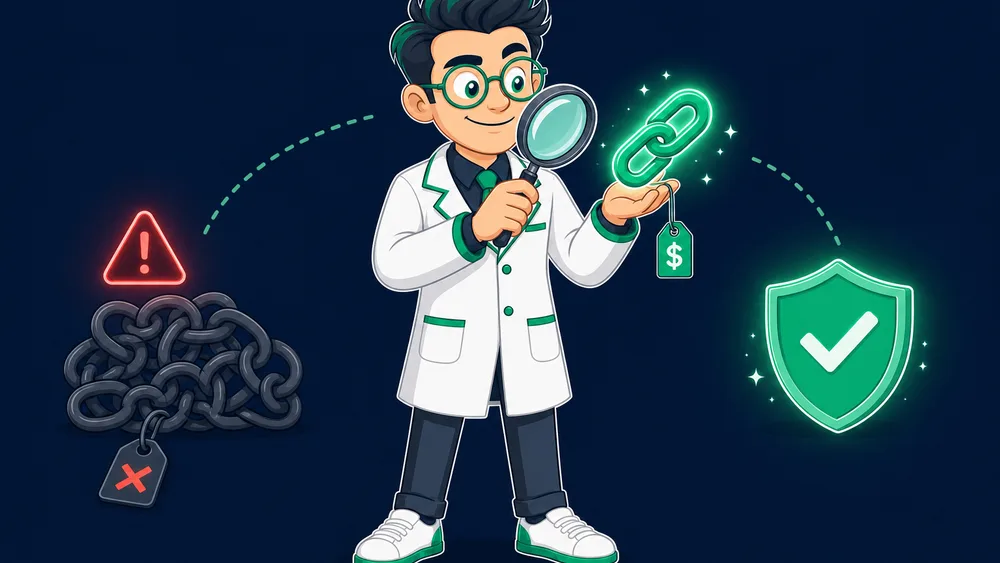
Paid backlinks are safe only when they are editorial: placed by a real publisher on a relevant site because the content earns it, not bought to pass ranking signals. Google’s link spam policy treats links exchanged for money to manipulate rankings as spam, and paid links that do pass ranking signals must carry rel="sponsored" or rel="nofollow". In 2026 the bigger risk is not a manual penalty but silent devaluation: Google’s SpamBrain AI quietly stops the link from counting, so you pay and get nothing.
This guide separates what Google actually penalizes from what buyers fear, then shows how to pay for links without gambling your rankings.
Are paid backlinks safe?
It depends entirely on what you are paying for. Paying a team to earn an editorial placement is safe; paying a site to insert a followed link purely to move a ranking is a link scheme.
Are paid backlinks against Google’s rules?
Paid links that pass ranking signals violate Google’s spam policies unless they are disclosed. Google’s spam policies list “buying or selling links for ranking purposes” as link spam, and Google’s guidance requires any paid or sponsored link to use rel="sponsored" or rel="nofollow" so it does not pass PageRank. A followed link bought only to influence rankings is the exact pattern Google classifies as manipulative. The rule is about intent and disclosure, not the invoice itself.
What makes a paid link safe instead of spam?
An editorial placement is safe because a real publisher chooses to link, not because money changed hands. The test that Google’s own guidance implies is simple: would this link exist if search engines did not? An editorial link on a relevant site with real readers would; a paid followed link on a site that sells links to anyone would not. We cover this line in detail in what is white-hat link building.
What does Google’s policy actually say about paid links?
Google permits paid links, but only when they are qualified so they do not pass ranking signals. The distinction the policy draws is between disclosed sponsorship and hidden manipulation.
Does Google allow paid links at all?
Yes. Google allows paid and sponsored links when they are marked with rel="sponsored" or rel="nofollow", per Google’s outbound link qualification guidance. A sponsored post is legitimate advertising when the link is tagged; the same post becomes link spam when a followed link is sold specifically to pass PageRank. Advertising is allowed. Buying ranking signals is not.
What counts as a link scheme?
A link scheme is any pattern designed primarily to manipulate rankings rather than serve readers. Google’s spam policies name several: buying or selling followed links, excessive link exchanges (“link to me and I’ll link to you”), large-scale article marketing with keyword-rich anchors, and automated link creation. Private blog networks (PBNs) are the textbook case, because every link exists only to pass ranking signals. If the primary purpose is ranking, not the reader, it is a scheme.
Penalty or devaluation: what’s the real 2026 risk?
The risk most buyers fear, a manual penalty, is now the rarer outcome. The more common and more expensive outcome is silent devaluation.
Will buying backlinks get your site penalized?
A manual penalty is possible but uncommon for typical buyers. Google’s Penguin algorithm, which launched in April 2012 and affected roughly 3% of search results, became part of Google’s core algorithm in real time on September 23, 2016, per Search Engine Journal. Since then, blanket manual actions for links have become less frequent, though a human reviewer can still issue an “Unnatural links to your site” manual action, which appears in the manual actions report in Google Search Console. Large, obvious schemes still draw penalties; a handful of mediocre paid links usually does not.
What is SpamBrain and how does it change the risk?
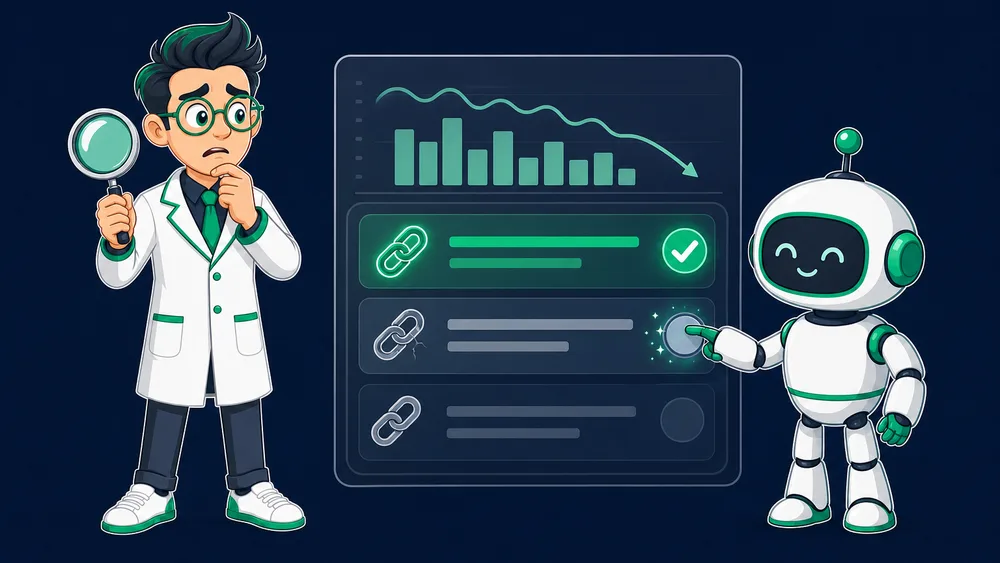
SpamBrain is Google’s AI-based spam-prevention system, and since the December 2022 link spam update it has been used to neutralize the value of manipulative links rather than only penalize them. In practice, SpamBrain devalues the link so it stops counting toward rankings, silently. This is worse for buyers than a penalty in one specific way. A penalty tells you to stop; devaluation just drains the budget while you wonder why 20 new links moved nothing.
Which paid links are safe and which are risky?
Safety tracks the placement type, not the price tag. Here is how the common options compare.
| Paid link type | How it works | Disclosure | Google risk | Verdict |
|---|---|---|---|---|
| Editorial outreach | Earn a placement with useful content + pitching | Follows editorial norms | Low | Safe, worth paying for |
| Sponsored post (tagged) | Pay for placement, link tagged rel="sponsored" | Required | Low (no ranking value passed) | Safe for traffic/brand, not ranking |
| Niche edit / link insertion | Add a link into an existing article | Site-dependent | Medium | Vet the site carefully |
| PBN / link farm | Bulk followed links from a controlled network | None | High (link scheme) | Avoid |
The pattern is consistent: a link on a relevant site with real readers is safe; a followed link bought on a site that exists to sell links is not.
How do you buy backlinks safely?
You buy the work of earning editorial placements, not the links themselves, and you keep control of quality at every step.
What does a safe buying process look like?
A safe process gives you visibility and aligns incentives. Three controls matter most: you approve every target site before outreach, the placement is editorial on a relevant site with real readers, and you pay on a pay-per-live-link basis so a link that never goes live costs nothing. This is the model we describe in how to buy backlinks safely. Before hiring anyone, run them through the checklist in how to vet a link-building agency.
How do you tell if paid links are hurting you?
Watch the gap between inputs and outputs. If referring domains climb but rankings stay flat, the links are being devalued, not helping.
What are the warning signs of bad paid links?
The clearest signal is growth in referring domains with no movement in target-keyword rankings over several months, which points to SpamBrain devaluation. A second signal is a manual action notice in Google Search Console for unnatural links, which requires cleanup and a reconsideration request. A third is a link profile dominated by exact-match anchor text, which no natural profile shows. If you find manipulative links you did not want, Google’s disavow tool is the last resort, not the first.
Common mistakes and misconceptions
The most expensive misconception is that “safe” means “won’t get penalized.” Safety in 2026 is really about whether a link counts at all. Buyers who optimize only to avoid a penalty still lose money on links SpamBrain quietly ignores. The second mistake is treating fabricated proof as harmless marketing: the FTC’s fake-review rule, effective October 21, 2024, makes invented testimonials and reviews illegal, with penalties up to $51,744 per violation. Safe link building avoids both the ranking risk and the legal one.
Quoteable takeaways
Quoteable takeaway: Paid backlinks are not inherently unsafe. Followed links bought to pass ranking signals are, because Google’s link spam policy classifies them as manipulation.
Quoteable takeaway: Since Penguin became a real-time part of Google’s core algorithm in September 2016, the dominant 2026 risk shifted from manual penalties to silent devaluation by SpamBrain.
Quoteable takeaway: A paid link is safe when a real publisher would keep it without search engines in the picture. Everything else is spending on a signal Google is built to ignore.
Frequently asked questions
Are paid backlinks safe?
Paid backlinks are safe when they are editorial placements on relevant sites with real readers. They are unsafe when a followed link is bought purely to pass ranking signals, which Google's link spam policy classifies as manipulation. The safest paid arrangement is paying a team to earn editorial links, not paying a publisher for a followed link.
Can you get penalized for buying backlinks?
You can, but a manual penalty is now uncommon for typical buyers. Since Google's Penguin update became real-time in September 2016, Google more often devalues manipulative links with its SpamBrain AI than issues a manual action. Large, obvious schemes like PBNs still risk penalties that appear in Google Search Console.
Do paid backlinks still work in 2026?
Editorial links earned through paid outreach still build authority. Bought followed links designed to game rankings increasingly do not, because SpamBrain devalues them so they stop counting. The result is wasted spend rather than a ranking boost, which is why placement quality matters more than link volume.
Do paid links need to be nofollow?
Yes, if the link is paid and would otherwise pass ranking signals. Google requires paid and sponsored links to use rel="sponsored" or rel="nofollow" so they do not pass PageRank. Editorial links earned through outreach are not paid placements in this sense, because the publisher chooses to link on the merits.
How do I know if bad backlinks are hurting my site?
Watch for referring domains rising while target-keyword rankings stay flat, which signals devaluation. Check the manual actions report in Google Search Console for unnatural-links notices. A profile heavy on exact-match anchor text is another red flag. Use Google's disavow tool only as a last resort for clearly manipulative links you cannot remove.
The safe way to pay for links
Paid backlinks are safe when you pay for editorial work, approve every target, and only pay for links that go live on relevant sites. That is the version that compounds authority instead of funding signals Google ignores. Want to see which links would actually move your rankings, and which risky ones already point at your site? Start with a free audit. If a link isn’t live, you don’t pay for it.